
Websites for Counsellors: Read This Before You Pay a Designer
Helen has twenty minutes and a cheese sandwich. Here's how to build a counselling website she can use before her lunch break ends.
Published by the GROW Formula® team · Updated

Helen has twenty minutes before her next meeting. She’s sitting in her car, eating a cheese sandwich and looking for a counsellor. She’s already spent three weeks getting as far as typing the words into Google. Today she’s done it. She’s even put Swindon in.
The first website opens with a film of the sea. Helen lives in Wiltshire, so this raises an immediate question about the commute. A sentence fades into view. Begin your journey towards a more authentic you.
Helen would quite like to know whether the woman works on Thursdays.
If you’re comparing websites for counsellors, whether you plan to build your own or hire a designer, keep Helen in mind. She needs to know who she’d be talking to, whether you can help with what’s bothering her, what it costs and how to take the first step. A small website can answer all four beautifully. Let’s build one she can use before her lunch break ends.
What should a counselling website say on the homepage?
The second website Helen opens belongs to a fictional counsellor called Ruth. There’s a recent photo of Ruth and, beside it, a few lines of ordinary English.
I’m Ruth, a counsellor in Swindon. I work with adults who find it hard to switch off from work, even when they’re at home. You can see me in person on Thursday evenings or online during the week.
Last night Helen was brushing her teeth when she caught herself rehearsing an argument with her line manager. She reads on.
Try writing your opening in that order. Give your name, say you’re a counsellor, tell people where you practise and describe something your clients would recognise in their own lives. Choose a web address close to your practice name. A client who hears about Ruth from a friend should stand a sporting chance of finding the same Ruth later.
Then pick two or three details that genuinely affect who can see you. Ruth mentions Thursdays because some of her clients can’t get time off work. Someone else might offer sessions in Polish or have step-free access from the pavement to the counselling room. If a detail would change somebody’s answer from “I couldn’t manage that” to “Actually, I could”, give it space near the top.
Show people who they’ll meet
Helen taps About Ruth. She wants to know whether she could sit opposite this person and say something she’s never said aloud. The photo helps. It shows Ruth’s whole face, dressed as she would be for a session. There’s also a photo of the room. Helen notices the two chairs are angled slightly away from each other. She likes that. She’d been picturing a job interview with crying.
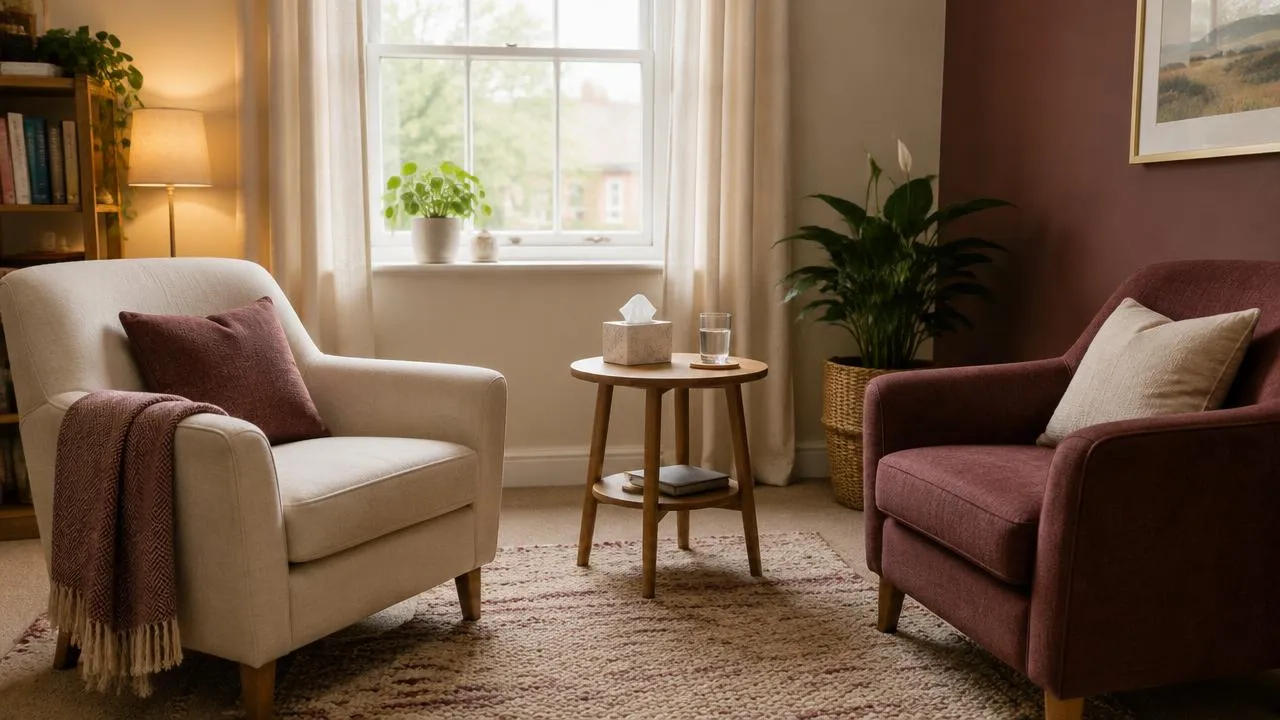
A short bio can do quite a lot here. Give your relevant qualifications, describe your experience accurately and explain what your approach means for the person in the other chair. If you call yourself an integrative counsellor, give an example of what that looks like in a first session. Helen has no strong views on integration. She does have strong views on being asked to produce a coherent opening statement at a moment’s notice.
Use the professional title, membership letters and logos you’re entitled to display. A link to your register entry gives readers a way to check your credentials. Take particular care with client stories and testimonials. A detail as small as a job title can identify someone in a small town. If you’re considering using client feedback, check your professional body’s guidance, protect confidentiality and obtain explicit permission for the specific use. You can show people how you work perfectly well with a description of a typical appointment. BACP Ethical Framework
Put fees, appointments and directions where people can find them
Helen’s thumb is now hovering over Fees and appointments. She has a figure in mind that she can afford. Asking a stranger what they charge and then explaining that she can’t afford it is quite a large social undertaking for someone who still says “lovely, thank you” after a disappointing haircut.
Ruth has written her service menu like this:
| Appointment | What to expect | Fee |
|---|---|---|
| Introductory phone call | 15 minutes to ask questions and see how you feel about working together | Free |
| Individual counselling | 50 minutes, in person in Swindon or online | £55 |
Those are illustrative fees. On your own site, use your actual prices and durations. If you offer a free introductory call, put it first on both the website and the booking system. Explain who phones whom. Ruth adds, “I’ll ring you on the number you give me.” That one sentence has just saved Helen from spending 15 minutes on Thursday engaged in a silent telephone stand-off.
For in-person work, include a map, recognisable directions, parking information and any steps. For online work, explain how the client gets the link. Keep fees and availability consistent wherever people find you, including your booking system and directory profiles.
Make the next step possible on a phone
At 12.52 Helen decides she’d like the free call. There’s a Book now button in the header on every page. It opens Ruth’s live calendar. Helen can choose an introductory call directly, without committing to a paid session or exchanging six emails about what each of them means by “late afternoon”.
Some people will still want to ask a question first. Offer a business email address, a mobile number and a short contact form asking for a name, email address and message. Say when you’ll reply, make your privacy notice easy to find and check that submissions actually reach your inbox. An initial enquiry can be as simple as “Is the room on the ground floor?” Leave people room to decide what they’re comfortable sharing.
Here’s a good test before you launch. Hand your phone to someone who hasn’t seen the site. Ask them to find the price of a session, check whether they could get into the building and book a call. Sit on your hands. The instant you hear yourself saying “You just need to tap the little leaf”, you have learnt something important about the little leaf.
Should you use a website builder or hire a designer?
A website builder is a sensible choice if you’re comfortable editing pages, connecting your booking system and testing the result on a phone. If every hour spent learning how menus work is an hour you’d happily pay to get back, a professional designer can take on the build and the behind-the-scenes work that helps search engines understand your pages.
When comparing quotes for counselling website design, ask four questions:
- What will I pay in the first year and each year after that? Include the build, domain name, hosting, booking software and maintenance.
- Can I change fees, hours and photos myself? Ask for a demonstration. One day you’ll need to change £55 to £60, preferably without convening a committee.
- What’s included for mobile and local search? Ask to try a finished site on your phone. See how quickly it loads and whether the page titles and headings make the service and location obvious.
- Who controls the domain and what happens if I leave? Make sure you understand how you’d keep the web address clients already know.
Give the designer the same brief you’d use yourself. A fast, simple site. A homepage that says what you do. A short bio and recent photo. Fees, location, contact options and a booking button people can find. Once those work, you can decide whether a short video, an explanation of your approach or a useful article would answer another question your clients actually ask.
At 12.56, Helen puts her phone away. She’s booked a call for Thursday. She knows what it costs, how long it will last and that Ruth will ring her. She finishes the sandwich.
Somewhere, on another website, the tide is still coming in.
Before putting more time or money into attracting counselling clients, check that your fees and the number of paid appointments you need add up. Setting Up a Private Counselling Practice: What to Charge and How Many Clients You Need.
When enquiries arrive, your availability, fees and therapeutic boundaries need to work for you as well as your clients. Protect your therapeutic boundaries.
More on be visible online

Where to go next
The same principle in other professions
Ideas often travel well between modalities.
5 Questions Your Homeopathy Website Should Answer
Pat has £80 and Tuesday afternoon free. Moira's website needs to tell her exactly what she's buying, without a single fern standing in the way.

5 Essential Acupuncture Website Fixes
Martin has been recommended by his sister and has his diary open. Kate's website needs to answer his questions about needles before a giant close-up puts him off.

5 Ways to Turn Massage Website Visits into Bookings
Leanne has £60, two shoulders and a Thursday afternoon off. Your massage website needs to help her book one good Thursday, not sit a philosophy exam.

4 Sports Therapy Website Fixes for the “Sporty Enough?” Problem
Rachel wants her Saturday run back, not a place in the professional squad. Your sports therapy website needs to show her she belongs.