
Massage Advertising: Where to Advertise and How to Tell What Gets Bookings
Before you spend money on massage advertising, decide which appointments you want to fill, who could realistically attend them and how you'll recognise a booking that came from the advert.
Published by the GROW Formula® team · Updated
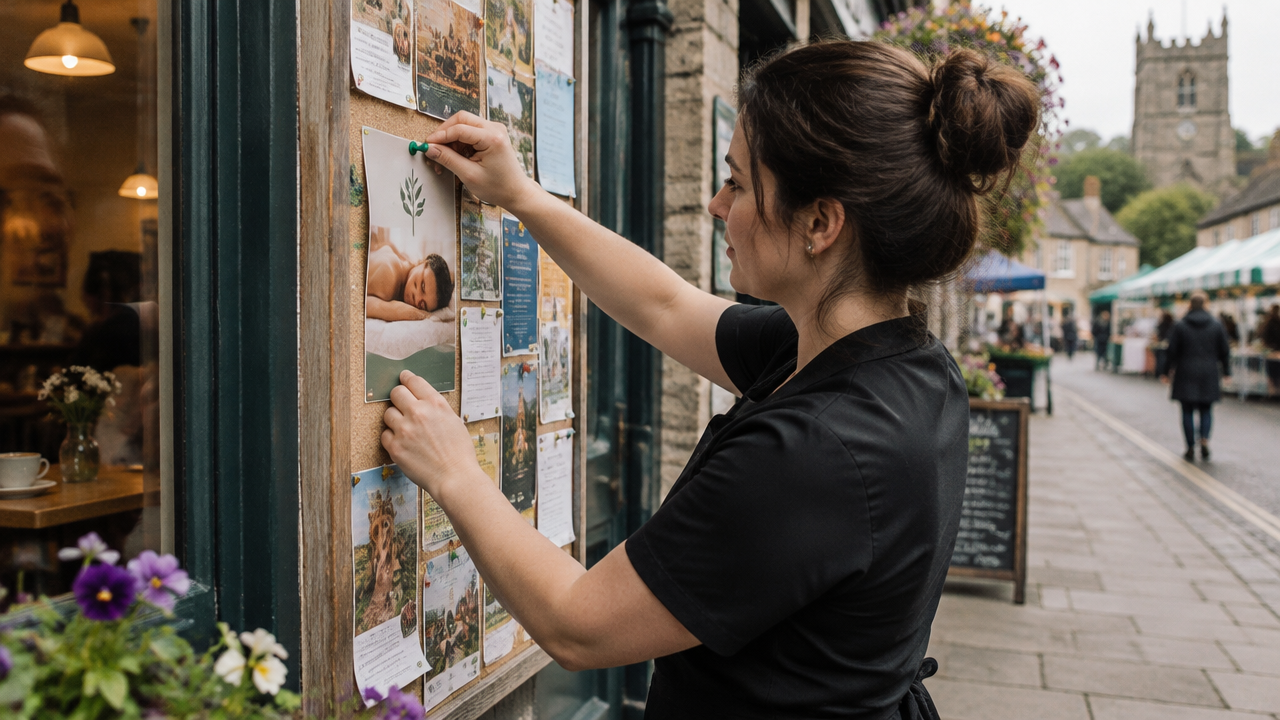
Six weeks after printing 500 massage flyers, Ellie finds one doing an excellent job of steadying a table in the café opposite her clinic.
“Have many people taken one?” she asks.
“Quite a few,” says the owner. “That table used to be much worse.”
Ellie knows the printing cost £65. She knows she spent most of a Sunday distributing the flyers. She also knows that three new clients have booked since then. Unfortunately, one is her sister’s neighbour, one found her on Google and the third said, “I’ve seen you about,” which in a town this size could mean the flyer or the reduced section in Morrisons.
Before you spend money on massage advertising, decide which appointments you want to fill, who could realistically attend them and how you’ll recognise a booking that came from the advert. Here’s how Ellie, a fictional massage therapist in Cheltenham, uses those three questions to decide where her next £100 should go.
Start with the empty appointment
Ellie’s Saturday sessions fill themselves. What she has available is a 40-minute back, neck and shoulder massage on weekday lunchtimes. Her treatment room is a four-minute walk from a cluster of offices. A client can get there, have the appointment and get back within an hour. Suddenly she has something more interesting to advertise than “massage available”.
Try finishing this sentence before choosing a channel: “I want to fill [appointment] with someone who [reason they’d choose it] and can get to [place] at [time].”
A mobile massage therapist looking for two home visits in the same neighbourhood on a Friday has a different advertising problem from someone offering sports massage beside a running track on Wednesday evenings. Buying the biggest local audience could leave either of them spending quite a lot of money reaching people who are enthusiastically unavailable.
Where should a massage therapist advertise?
Find a channel where the people you want to reach already gather, or where they actively look for the service. Then ask what it costs to appear there and what you can measure afterwards.
| Place to advertise | When it’s worth testing | What to ask or check first |
|---|---|---|
| A local employer bulletin or business park newsletter | You offer appointments that fit around the working day, close to the workplace | Does it accept paid listings? Which sites receive it, when is it sent and can you include a direct booking link? |
| A running club, gym or studio newsletter | You offer a relevant service within your training and can see members near where they train | Ask the organiser what members actually enquire about. Agree the placement and fee, and supply the link for that specific service. |
| A community magazine or well-placed noticeboard | You see clients in a defined neighbourhood or want to group mobile visits locally | Check the distribution area or footfall, publication dates and space for a short web address or QR code. Include printing and delivery time in the cost. |
| A local Google search advert | Someone looking for your type of massage in your area can book directly | Set a spending limit. If you hire a specialist, ask them to show you which searches you paid for and how you’ll connect a booking click to an attended appointment. |
Ellie picks two: the business park bulletin and a small Google search campaign. She leaves the running club for another time. Her lunch-hour clients don’t need to share a hobby. They need to share a lunch hour.
Write a massage advert that earns the click
The first version Ellie drafts says, Escape the everyday. Reconnect. Restore. Renew. Her friend reads it and guesses that the business sells bathrooms.
Use the four questions behind the GROW Formula’s AIDA exercise. Attention: where will the right person see this? Interest: which words will make them recognise their own situation? Desire: what detail makes this particular session worth having? Action: how do they book it?
Here’s Ellie’s entry for the business park bulletin. All prices and campaign figures in this article are illustrative.
A massage that fits inside your lunch hour. I’m Ellie, a massage therapist four minutes’ walk from the business park. My back, neck and shoulder appointment takes 40 minutes from arrival to finish and costs £40. We’ll agree the pressure and where you’d like me to spend the time. See this week’s lunchtime appointments and book online.
Someone searching Google already has massage in mind, so Ellie starts with the service and place. Example wording for a search advert:
Lunchtime Massage in Cheltenham. Back, neck and shoulder massage. £40 for a 40-minute visit near the business park. View times and book online.
Both adverts make the same offer at the usual price. The first one gives someone reading the office news a reason to consider a massage today. The second gives someone already looking a reason to click Ellie’s result. Neither requires her to earn less for the same pair of shoulders.
Use details you can deliver. If “40 minutes” means hands-on treatment plus ten minutes either side, advertise the total time too. Be equally careful about outcomes. UK advertising guidance accepts wording about relaxation and relief of everyday stress. Stronger treatment claims require appropriate evidence. CAP guidance on massage and bodywork
Send each advert to the appointment it describes
Imagine taking the trouble to click Lunchtime massage, only to find yourself on a homepage offering hot stones, gift vouchers, a practitioner biography and a candid account of how Ellie first discovered lavender in Provence. You have learnt something about Ellie. You still don’t know whether she’s free at twelve.
Link both adverts to a page for that 40-minute appointment. Repeat the location, total time and fee, show live lunchtime availability and put Book a lunchtime massage beside it. Try the journey on a phone. Check that the price stays at £40 and that the booking confirmation tells the client which door to use.

Give each channel its own trackable link. Ellie labels one office bulletin and the other paid search. For a printed advert, a unique short URL and QR code can lead to the same page. Check whether the booking system preserves the source when someone moves from the website into its calendar. If it loses that information, add a brief “How did you hear about this appointment?” question. Leave room for I don’t remember. Making up an attribution is no improvement on a wobbly table.
Count attended first appointments, then do the maths
Ellie gives the two adverts the same four-week run, offering the same service. She records spend, the time she puts in, bookings and attendance. At the end she gives appointments booked during the test time to take place. Now she can compare what each channel bought.
| Four-week result | Office bulletin | Google search advert |
|---|---|---|
| Advertising spend | £40 | £60 |
| New-client bookings | 4 | 5 |
| Paid first appointments attended | 4 | 3 |
| Advertising spend per attended first appointment | £10 | £20 |
| Revenue from those first visits at £40 each | £160 | £120 |
The Google advert wins on bookings. The bulletin brings in one more paying client for £20 less. Ellie’s calculation is advertising spend ÷ new clients who attended and paid. If she paid an agency or designer, she’d include the relevant fees. She also notes her own time separately, because those Sundays spent delivering flyers contained other possibilities.
Is £20 too much to acquire a £40 client? Look at what remains after delivering the appointment. Suppose Ellie allows £8 for the costs attributable to each visit. A £40 first appointment then leaves £32 before advertising, her own pay and other overheads. After the £20 acquisition cost, £12 remains towards those last two. If that doesn’t support the income she needs, the campaign requires a change, however handsome its click-through rate.
This little test is enough for a decision about next month, rather than a lifetime allegiance to office newsletters. Ellie books another bulletin placement. Before spending more on search, she checks why two booked visits didn’t go ahead and which search terms brought visitors. She’ll also check how many clients from each group return at full price. Repeat visits can change the economics. They can join the spreadsheet when they actually happen.
Back at the café, the owner offers Ellie another spot for her flyers. This time she agrees to a small batch with a link just for the café. Four weeks, then she’ll see.
“And if nobody books?”
The owner puts two coffees down. Neither spills a drop.
Where to go next
The same principle in other professions
Ideas often travel well between modalities.

How to Get Clients as a Personal Trainer: From First Conversation to First Paid Session
There's often a gap between somebody wanting your help and knowing what a first session with you would involve. Here's how to close it without conducting a sales presentation beside a kettlebell.

Physiotherapy Marketing: How to Find Out Where New Patients Come From
When a new patient says “Google”, that may only be the last step. Two questions reveal who really sent them, and where your next marketing pound should go.