
3 Pages Your Craniosacral Therapy Website Actually Needs
June wants to know about trousers, Fridays and fifty pounds. Three useful pages can help your craniosacral therapy website answer the questions that matter.
Published by the GROW Formula® team · Updated

By the time June finds out whether she keeps her clothes on, she knows where the practitioner trained, who taught his teacher and which book he took to Dorset in 2014.
She’s pleased he enjoyed the book. She would still have preferred to hear about the trousers first.
The practitioner is her friend Michael. He’s asked her to look over his new craniosacral therapy website because she’s exactly the sort of person he hopes will use it: interested, local and unfamiliar with the therapy. He makes tea while she reads. When he comes back, she’s on a page called Stillness.
“What do you think?” he asks.
“I think I’d like an appointment. I’ve got fifty quid and Fridays off. How am I doing?”
Michael takes the laptop. He knows he’s put the price somewhere. A brief but spirited search reveals that the only person who can currently afford to find out his fee is somebody with Fridays off.
If you’re deciding what to put on a craniosacral therapy website, try a three-page version first. For a solo practice, Home, Your first visit and Fees and booking can do most of the work. Each answers a different question. Together they give June enough information to make up her own mind, preferably while the tea is still hot.
Page 1. Home: “Have I found the right person?”
June arrives with two pieces of information from a friend: his name is Michael and he works somewhere near Lewes. At the top of the page she sees Welcome to a space for stillness. It’s a lovely sentiment. It would also fit a Quaker meeting house, a library or the carriage on the train where Michael inadvertently answered his phone.
Give the first few lines to your name, the service, the location and a plain description of what somebody would experience. For example:
Craniosacral therapy in Lewes with Michael Lane I offer one-to-one sessions for adults in my ground-floor practice near the station. Craniosacral therapy is a gentle, hands-on complementary therapy. You stay fully clothed, and we agree where you’re comfortable with me placing my hands.
That’s enough introduction for a new visitor. Add a recent photograph in which they can recognise you, your relevant qualification and a link to your register entry if you have one. Give them two distinct options: What happens at a first visit? and See fees and book.
A short bio can live on this page. Keep one detail that gives the reader a feel for working with you. Michael’s draft says he has “a longstanding commitment to holding space”. In person, he tells June, “Some people like me to explain what I’m doing as I go. Others come for an hour without conversation. I ask which they’d prefer.” June puts a pencil tick beside that sentence. “There you are,” she says.
Page 2. Your first visit: “What will happen when I get there?”
This is where a little more information earns its place. Michael knows what light touch means in his practice. June is picturing somebody holding her head for an hour and wondering what happens if she needs to turn it.
Describe the visit in the order it happens. Start when the client comes in, carry on as far as the first contact and explain how they can ask for a change. Something like this, adapted to the way you work:
We’ll sit down first to talk about what brings you here and any questions you have. If you’d like to go ahead, you can lie on the treatment couch in your usual clothes. I’ll explain where I suggest placing my hands, which might include your feet or head, and ask whether that feels comfortable. You can ask me to move my hands, change position or stop at any point.
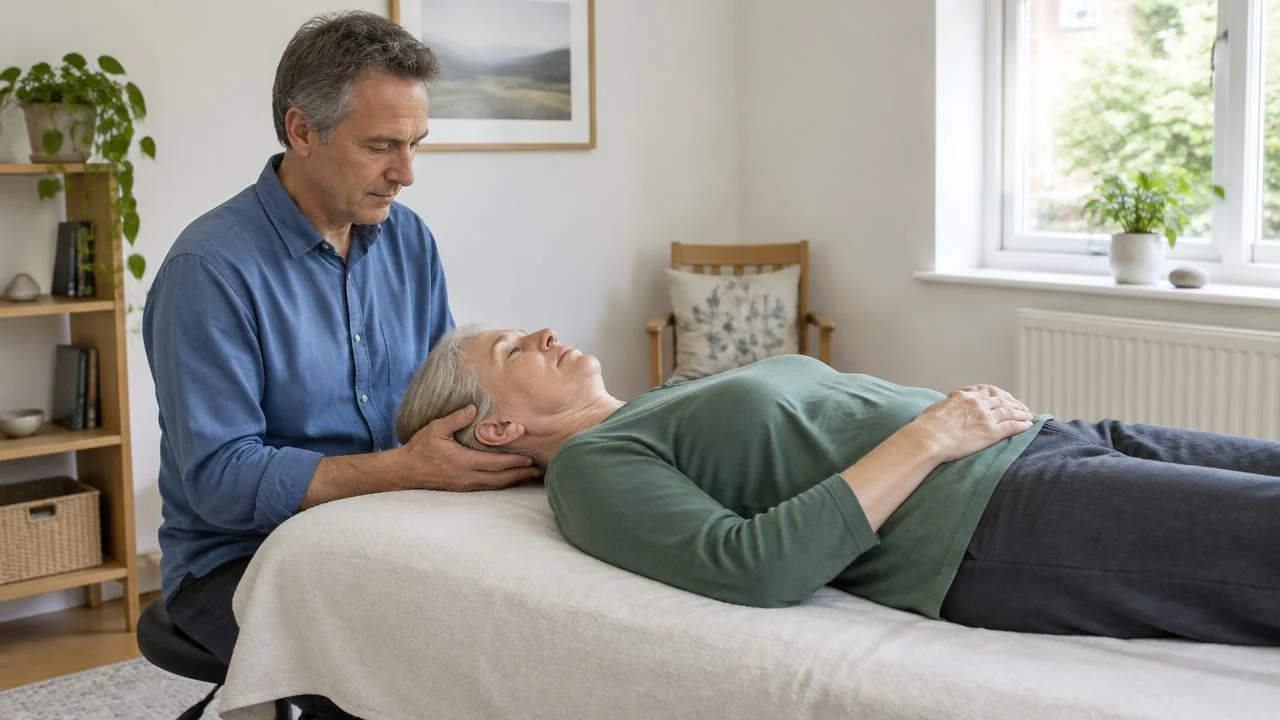
That paragraph tells June something she couldn’t infer from a photograph. It also gives her permission to interrupt the silence without feeling she’s spoilt a process she dimly remembers reading about on page seven. The Craniosacral Therapy Association’s client guidance emphasises that people remain clothed and can choose where a practitioner makes contact. CSTA guidance for clients
Underneath, answer the two or three practical questions your clients actually ask. For Michael, those are whether there’s a step, whether he can offer a seated appointment and whether the advertised hour includes the conversation at the beginning. For you they might be different. Look at recent enquiries. A question three people have taken the trouble to email deserves more space than a paragraph you’ve kept because it took all Sunday to write.
Be careful when cutting explanations down. A short, confident claim can be more misleading than a long one. Describe the touch you use and the choices people have. UK advertising guidance allows room to describe relaxation and a sense of wellbeing. Claims that craniosacral therapy treats medical conditions need robust evidence. Check photos, captions and any testimonials you publish with permission for implied claims as well. CAP guidance on craniosacral therapy
Page 3. Fees and booking: “Can I make this work?”
June has been uncommonly explicit about her budget and her day off. Michael answers by putting the fee, duration and live availability together. His example looks like this:
First visit · 60 minutes · £50 Includes our initial conversation and time for hands-on work if you choose to go ahead. Friday appointments are available in Lewes. See available times.
Use your own prices and schedule. List the follow-up fee alongside the first-visit fee. If you offer a free introductory call, put it first and say how long it lasts and who calls whom. Include your cancellation terms where people can read them before committing. Use the same appointment names and prices in your booking calendar.
Put the address, a map link, directions and useful access details here too. Someone who’d rather ask a question should be able to find a business email, mobile number or a short contact form, together with a realistic reply time. Keep a booking link visible on all three pages. Some people will read every word. Others already know you, have been paid today and would just like next Friday at eleven.
What can you take off the homepage?
Michael prints the old site and lays it across the kitchen table. For the first time since starting his practice, he can say with confidence that craniosacral therapy occupies the whole of his kitchen and part of a neighbouring chair.
June helps him sort it out.
| If your draft contains… | Give it this much space |
|---|---|
| A detailed account of your training and the origins of your approach | Keep the relevant qualification and one sentence about your approach. Link to further reading for the curious. |
| A footnote explaining what another footnote meant by “primary respiration” | Explain the hands-on experience on the first-visit page. Give specialist theory its own optional link if readers ask for it. |
| The same welcome, in slightly different words, on four pages | Keep the warmest version. Use the space you’ve freed up for a practical detail, or simply let the page end. |
| A privacy notice, cancellation terms or information about raising a concern | Keep it easy to find. Use plainly labelled links in the footer and at the form or booking step where the information matters. |
| Your reflections on the book you took to Dorset | An article, if you have something worth saying about it. The homepage has done its bit for Dorset. |
Before you publish, open the site on a phone and hand it to someone who’s never had craniosacral therapy. Ask them to find the fee, explain what happens at the first visit and show you how they’d book. Then ask what they still want to know. That last question tells you where cutting another sentence would be a mistake.
On Friday at eleven, June arrives in Lewes with fifty pounds and a perfectly ordinary pair of trousers. She knows what she’s booked, who she’s meeting and that she can ask Michael to move his hands. She even knows where to park.
Halfway through tea afterwards, she asks about the book. Turns out she goes to Dorset too.
Before putting more time or money into attracting craniosacral clients, check that your fees and the number of paid appointments you need add up. Do the maths for your practice.
Once craniosacral clients find you, what happens before, during and after their appointment matters too. Give great service in your practice.
Where to go next
The same principle in other professions
Ideas often travel well between modalities.

Websites for Physiotherapists: 5 Ways to Make a First Appointment Easier to Book
Try looking at your website with a new patient's one piece of information: they know what they're finding difficult. Can they use that knowledge to choose the right appointment?
SEO for Yoga Teachers: 5 Ways to Help Local Students Find Your Classes
SEO for yoga teachers starts with giving each regular class a web page people can find, recognise and use this term.
SEO for Massage Therapists: 5 Ways to Get Found for the Bookings You Want
The point of showing up in a local search is to have the right person book the right service, ideally at an address where one of you is expecting the other.
SEO for Counsellors: 5 Ways to Get Found Without Asking Clients for Reviews
You can’t put a review QR code on the consulting room door. SEO for counsellors is about making the words you publish meet the question a client is willing to type.