
4 Photos Your Shiatsu Website Needs (and What to Write Underneath)
Anna’s friend Val wants the brown chair back in shot. Four photographs and useful captions can answer the questions newcomers hesitate to ask.
Published by the GROW Formula® team · Updated
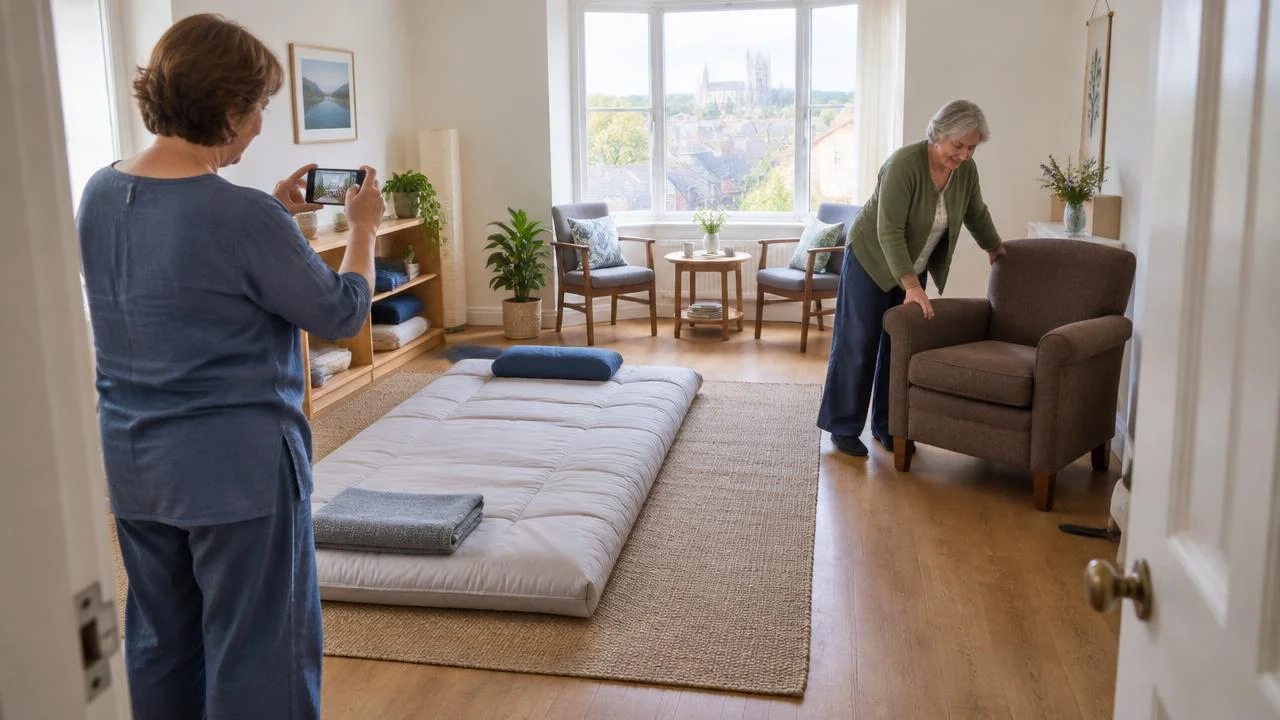
“Could you take that one again, but leave the chair in?”
Anna looks at the photograph she’s just taken of her Shiatsu room. Her friend Val has spent the morning helping her make the place look presentable. Between them they’ve hidden a cable, straightened a picture and negotiated the removal of a spider on terms unusually favourable to the spider. Now Val wants a brown chair back in shot.
“It’s a photo of the futon,” says Anna.
“Yes. That’s why I’d like to see the chair.”
Val quite fancies trying Shiatsu. She can get down onto a futon perfectly well. Getting back up is a more collaborative enterprise, usually involving a sturdy piece of furniture and a brief period in which everyone kindly looks elsewhere. She’d seen Anna’s old website months ago. She’d assumed the floor was compulsory.
If you’re building a Shiatsu website, here’s a job you can do in an afternoon. Take four photographs that answer questions a newcomer might feel awkward asking. Then write the words that make each picture useful. Anna, our fictional practitioner in Exeter, starts by reinstating the chair.
1. Show the room from the doorway
Stand where a client first sees your room. Take a photograph that shows where they’ll sit to talk and where they’ll receive Shiatsu. If you work on a floor futon and also offer a treatment table or seated sessions, let people see those options. The photograph doesn’t need to pass an estate agent’s test for making a room look implausibly large. It needs to look familiar when someone arrives.
Anna’s first caption was A peaceful space to restore balance. After talking to Val she replaces it with this:
We’ll start with a chat in the chairs by the window. You can receive Shiatsu on the padded floor futon or seated in the brown chair. If getting down to the floor is difficult, you’re welcome to choose the chair when you book. Both options cost the same.
Those last two sentences make it possible for Val to book privately. She can choose what works for her without first emailing a stranger an account of getting up after Christmas presents.
Describe what your own practice can accommodate. A chair in the photograph could equally be where you put the laundry. Your caption is what turns it into information. Repeat the important details in ordinary page text so visitors can read them without loading the image. Add a short, descriptive alternative text for people using screen readers.
2. Show what the practitioner and client actually do
Val has another question. She’s seen a photo of someone holding a client’s leg in the air. “Whose job is it to keep it up there?” she asks. “Because if it’s mine, it would be useful to know how long you’ll want it.”
It’s easy to forget how much of a Shiatsu photograph is obvious only to someone who practises Shiatsu. Use a willing model to show a moment someone might actually experience at a first visit. Choose an angle that makes the position, the clothing and the contact easy to see. Then explain whose hands are doing what.
Here I’m working through clothing, using my palm to apply pressure while the client rests on their side. Before we begin, we’ll talk about how you’d like to be positioned. I’ll check how the pressure feels, and you can ask me to change it or pause at any time.
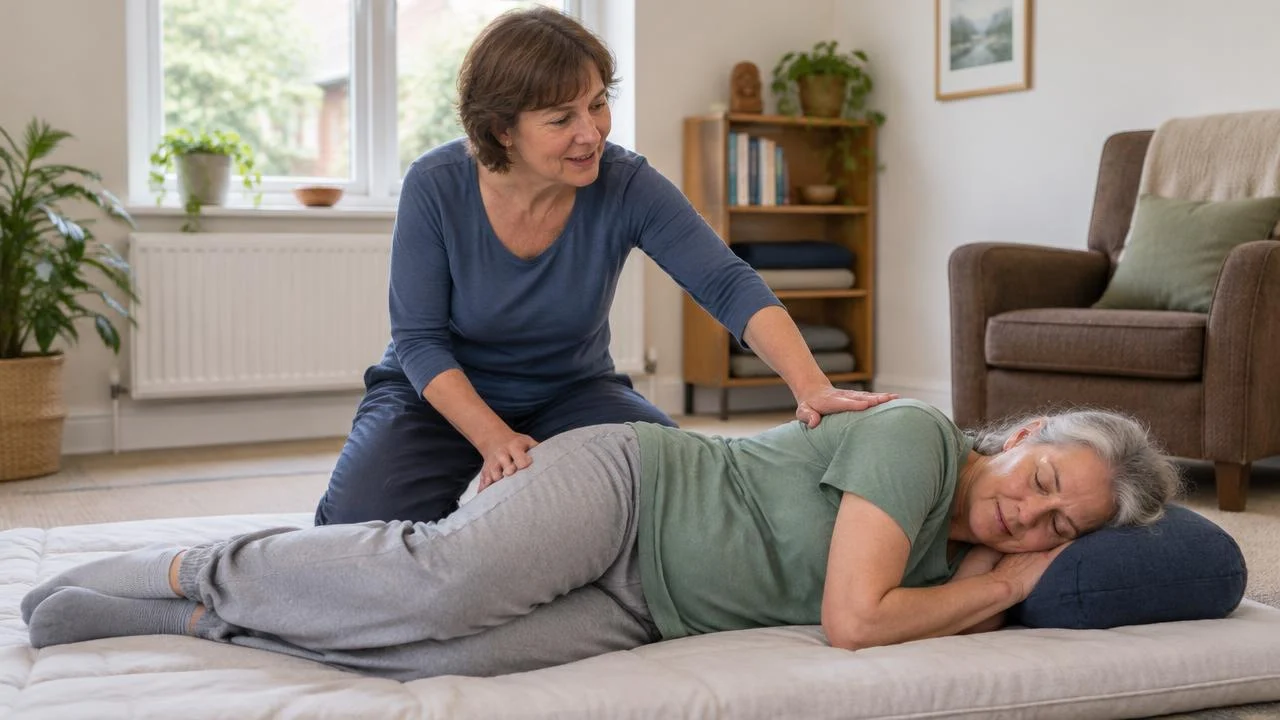
For a first-time visitor, that caption answers several questions at once. They can see that they stay dressed, that they can speak and that they aren’t expected to have learnt a sequence of moves. If you suggest soft, loose-fitting clothes and socks, give an everyday example. Jogging bottoms and a T-shirt are fine may be the most reassuring sentence on the page. The Shiatsu Society describes Shiatsu as hands-on work through clothing that can include pressure and stretching. Its patient information is a useful reference when writing your own explanation. Shiatsu Society FAQs
There’s room here for why you practise as you do. If Ki or meridians are central to your approach, explain what those ideas mean within the Shiatsu tradition and what they lead you to do in a session. Be careful about promising health outcomes. UK advertising guidance gives relaxation, easing tension and aiding sleep as examples of claims likely to be acceptable. Claims about treating a particular medical condition need appropriate evidence. Apply the same care to any testimonials you publish with permission. CAP guidance on Shiatsu
3. Show the face someone will see when they open the door
Anna owns an excellent portrait taken at a wedding. Unfortunately, there’s half a champagne flute in it and somebody else’s hand on her shoulder. Cropped tightly enough for professional use, she looks like a woman being detained at a wedding.
Get a recent, recognisable photograph of yourself in the clothes you normally wear to practise. Beside it put your full name, the town you work in, your relevant Shiatsu training and any current professional membership a client can check. If a local yoga teacher regularly sends people your way with “Ask for Anna”, make sure someone searching for Anna Shiatsu Exeter can recognise the person they’ve been sent to.
Use a few lines of your bio to describe the kind of session you’re especially well placed to offer. For Anna, who enjoys introducing people to Shiatsu, that might be:
If you’ve never tried Shiatsu, I’ll show you the positions we can use and explain what to expect before we start. You’re welcome to ask questions as we go. If you’d prefer some time without conversation once you’re settled, that’s welcome too.
Then give the reader somewhere to go. A Book a first Shiatsu session button should open a calendar with real availability. Near the button put the whole fee, the total time and what that time includes. For example, First Shiatsu session, 60 minutes, £55, including our conversation and time to get comfortable. Use your actual figures. If choosing a seated session changes the length, price or venue, show that before someone picks a time.
4. Show the last few metres of the journey
The map pin for Anna’s rented room lands in the middle of a courtyard. From there, a visitor can see a hairdresser, two identical green doors and a brass plaque announcing a solicitor who left in 2014. The solicitor, despite moving on professionally, continues to attract a small but steady stream of people in jogging bottoms.
Take the photograph from the direction most visitors approach. Caption it with the bit a map can’t tell them: “Use the green door beside the hairdresser. Ring the upper bell marked Anna. There’s one step at the entrance.” Add the clinic address, a map, directions from parking or public transport and accurate details about steps, lifts and toilets. A seated session indoors only helps someone who can get through the door.
Give these pictures a final rehearsal on a phone using mobile data. Are they quick to load? Can you read the captions without pinching and zooming? From any page, can you book or find a mobile number, business email or simple enquiry form with a realistic reply time? If you offer a free introductory call, list it first in your booking menu so people can ask about practicalities before committing.
On the afternoon Anna takes the new site live, Val opens it at her kitchen table. She taps First Shiatsu session, picks Friday and selects Seated. The confirmation says Anna will have the brown chair ready.
“Oh good,” says Val. “I know the one.”
Before putting more time or money into attracting shiatsu clients, check that your fees and the number of paid appointments you need add up. Do the maths for your practice.
Once shiatsu clients find you, what happens before, during and after their appointment matters too. Give great service in your practice.
Where to go next
The same principle in other professions
Ideas often travel well between modalities.
How to Build a Personal Trainer Website That Gets More Bookings
Mo wants help with the rowing machine, not an application to change his life. Build your website around a first meeting that new clients can actually book.

How to Build a Doula Website That Overcomes Hesitation
Maya and Jo want to know who will turn up, what support includes and what it costs. Four website details can help families picture working with you.

SEO for Physiotherapists: 5 Ways to Help Local Patients Find Your Clinic
Local SEO for physiotherapists starts with matching a patient's words to a service you actually deliver, in a place they can reach.
Websites for Physiotherapists: 5 Ways to Make a First Appointment Easier to Book
Try looking at your website with a new patient's one piece of information: they know what they're finding difficult. Can they use that knowledge to choose the right appointment?